


A Plastic-Free Future: Revitalising Traditional Knowledge in the Pacific

Updated: May 7
Across the Pacific, plastic pollution is a visible and urgent threat to the region’s environment, economy, and way of life. The problem has grown so severe that Pacific leaders rank it alongside climate change in urgency. While Pacific Island nations contribute less than 2% of global plastic pollution, they bear a disproportionate share of its impacts. In the Pacific, most plastics are imported, single-use, and often cannot be recycled locally, as the majority of the Pacific lacks recycling facilities to minimise plastic waste. As a result, the bulk of this waste ends up in landfills or leaks into waterways and oceans.
Nevertheless, the Pacific also holds the knowledge and wisdom to reduce its reliance on single-use plastics. It is therefore crucial for the Pacific to revitalise traditional and indigenous knowledge to utilise its abundant natural resources as an alternative to single-use plastics.
Revitalisation of Traditional and Indigenous Knowledge
Long before plastic bags and polystyrene containers became everyday items, Pacific communities relied on nature for their needs. Woven baskets from pandanus leaves for storing and carrying items, pottery vessels for storing water, and banana leaves for wrapping food were not only practical but also biodegradable, reusable, and in harmony with the environment.
These are solutions for a plastic-free Pacific. For example, in New Zealand, the kete—a traditional flax bag—surged in popularity after the 2018 ban on single-use plastic bags. In Papua New Guinea, women artisans weave bilums from natural fibres, selling them locally and through online platforms to customers in Australia and New Zealand. In Fiji, the tabekasere basket, woven from bamboo, lasts up to three years and is fully compostable. These are living examples of how traditional and indigenous knowledge can provide sustainable, scalable alternatives to plastics.

Image AI Generated
Leveraging Traditional Knowledge with Innovation and Nature
While tradition offers a strong foundation, innovation is expanding the possibilities of how traditional knowledge can be applied at scale. Early successes with plastic substitutes in the Pacific and around the world prove that it is feasible to combine local resources with modern technology. For example:
Seaweed-based packaging: Abundant in the region, seaweed can be transformed into biodegradable films for food wrapping.
Starch-based bags: Cassava, taro, potato, and pineapple stem starch can be used to make single-use bags that break down naturally.
Pineapple leaf leather: Inspired by projects in the Philippines, Pacific entrepreneurs could turn agricultural waste into durable, vegan-friendly materials for shoes, bags, and furniture.
Fish leather: In Samoa, a pilot program is using fish skin to make wallets, jewellery, and other goods, creating value from a by-product of the fishing industry.
These innovations open opportunities not just for environmental gains but also for new industries, jobs, and exports.
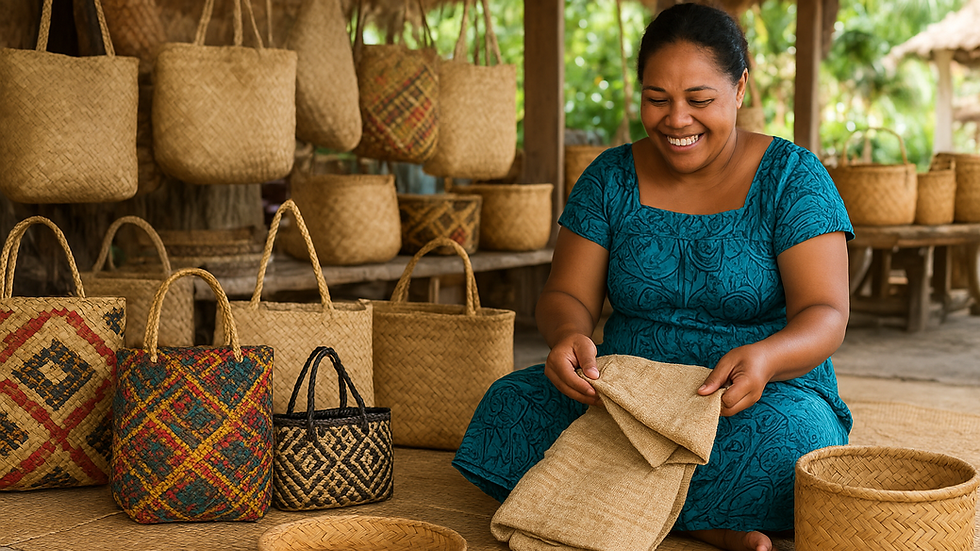
Image AI Generated
Can We Achieve Change?
Despite the promise, scaling up plastic substitutes in the Pacific faces significant hurdles. Cost is a significant barrier. Producing bamboo straws, for instance, is more expensive than manufacturing plastic ones. Tariffs often favour plastic over eco-friendly alternatives. For example, globally, plastic takeaway containers face an average tariff of 9%, while paper containers face 15%. Fossil fuel subsidies also keep plastic artificially cheap.
Beyond this, there are also infrastructure gaps. Without access to modern manufacturing facilities, many substitute products remain small-scale and handmade. Additionally, limited technical expertise and a lack of financing further slow progress. There is also a need for awareness. Many consumers are still unfamiliar with the environmental and health impacts of plastics or with the benefits of substitutes. Behaviour change campaigns will be key to shifting demand.
Tourism as a Catalyst
Tourism, a cornerstone of many Pacific economies, could be a powerful driver for adopting plastic substitutes. Eco-conscious travellers increasingly seek destinations that align with their values, and hotels, resorts, and restaurants are beginning to respond by eliminating single-use plastics. Scaling up these initiatives could see a Pacific where resorts serve drinks with bamboo straws, takeaway foods are wrapped in banana leaves, and room décor is made from tapa cloth and fish leather. These choices not only reduce plastic waste but also showcase Pacific culture and craftsmanship to the world.
A Call to Action
The Pacific’s journey away from plastic is both a return to its roots and a leap into innovation. To succeed, the region will need:
Policy support: That will incentivise local production and fairer tariffs for eco-friendly products.
Investment: To provide financing, technology, and training for small businesses.
Awareness campaigns: To inform and educate consumers about alternatives.
Tourism partnerships: To create niche markets for sustainable products.
With 98% of its territory covered by ocean, the Pacific has the most to lose from unchecked plastic pollution—but it also has the knowledge, creativity, and natural resources to lead a global shift toward sustainable materials. From the humble kete to high-tech seaweed packaging, innovative solutions are being developed. The challenge now is to weave them into a stronger, more resilient future for the region.
Summary of my blog:

Read the full report here: Plastics Substitution: Current Initiatives and Potential Options for the Pacific
Listen to the Podcast and Vidcast of this Report below:
Podcast AI Generated
Vidcast AI Generated


Comments